 How-to
Risks of Separate Templating and Fabrication: Why One Team Matters
Last Updated: November 28, 2026
Quick Summary
Separate templating and fabrication creates a gap where nobody owns the final fit, so every error becomes a debate instead of a fix. The main risks are blame ping-pong, remakes at your cost, lost slab matching, and schedule drift that adds days or weeks to a remodel.
- The break usually happens when template files transfer to the shop that cuts the stone.
- Digital templating cannot capture verbal warnings about site conditions or verify cabinets are level.
- A documented slab layout and seam plan approval before any cut converts blame debates into a record.
- Any site change after templating should trigger a re-template, not a guess.
- A written scope should name one party responsible for the finished fit, not just their step.
Table of Contents
- What are the risks of separate templating and fabrication?
- Inside the countertop templating process: where handoffs break
- Digital countertop templating: does it close the gap?
- Countertop seam placement and slab layout when two shops touch the job
- Countertop installation coordination: who owns the fit on install day
- Get Your Stone Project Under One Roof
- Frequently Asked Questions
What are the risks of separate templating and fabrication?
Splitting templating and fabrication between two providers creates a gap where nobody owns the final fit, and that gap is where expensive mistakes live. When the shop that measures is not the shop that cuts, every error becomes a debate instead of a fix.

This guide breaks down where those handoffs fail and what can go wrong when a template travels to a shop that never stood in the kitchen.
A template is a set of numbers and shapes. A fabricator reads those numbers without ever seeing the cabinets, walls, or out-of-square corner that made the template tricky.
The risks stack up fast:
- Blame ping-pong. The templater says the shop cut wrong. The shop says the template was wrong.
- Remakes at your cost. A misfit slab often means a new slab, a new cut, and a new install date.
- Lost slab matching. The piece you fell in love with may not match the replacement.
- Schedule drift. Every re-templating visit adds days or weeks to a remodel.
The countertop templating process is not just measuring. It is a judgment call about how a specific slab will sit on specific cabinets. Separate that judgment from the cutting, and you separate the job from the person who understands it.
The article lists the main risks of splitting templating and fabrication between two providers.
| Risk | What happens |
|---|---|
| Blame ping-pong | Templater and shop each blame the other |
| Remakes at your cost | New slab, new cut, new install date |
| Lost slab matching | Replacement piece may not match |
| Schedule drift | Re-templating adds days or weeks |
Inside the countertop templating process: where handoffs break
Templating moves through four stages, each a chance for information to fall apart when two companies share the work.
- Site visit and measuring. The templater records cabinet runs, wall angles, and appliance openings.
- Template creation. Physical or digital, the template captures the shape of the finished surface.
- Transfer to fabrication. The template files go to the shop that cuts the stone.
- Final installation. The finished pieces go back to a site someone may not have seen since step one.
The break usually happens between steps two and three. A templater notes "wall bows out, plan for a scribe," the note gets lost in an email, the fabricator cuts a straight edge, and the gap shows on arrival.
A clean digital file does not carry every warning. Files carry geometry, not the conversation.
Physical versus digital templates: what gets lost in translation
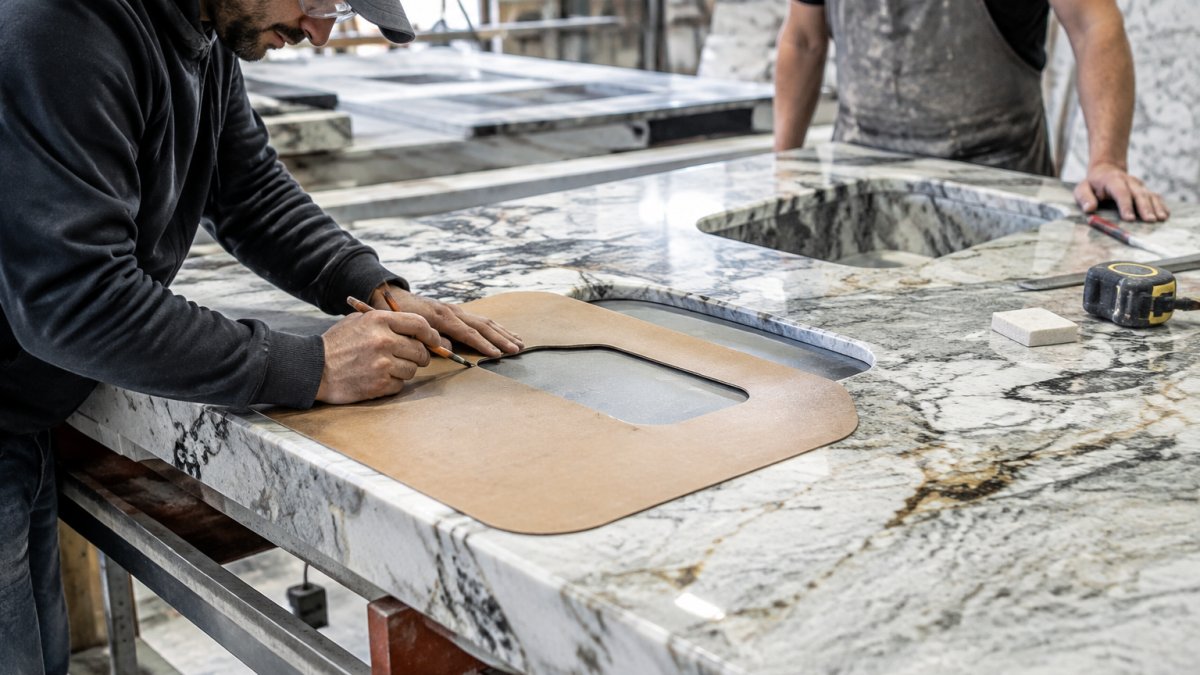
Physical templates are rigid or semi-rigid outlines, often made from strips, cardboard, or thin plywood, that trace the actual cabinet and wall edges. Digital templates use a measuring device to capture points and build a file.
Physical templates carry real-world quirks in their shape. Digital templates carry precision but depend on the operator's settings. Neither survives a handoff to a stranger without context.
What gets lost is the "why." A digital layout shows a notch but not that the notch exists because the refrigerator door swings wide. The fabricator who never saw the kitchen cuts it wrong, and the door hits stone.
Digital countertop templating: does it close the gap?
Digital countertop templating improves accuracy but does not fix a split workflow. The file is only as good as the person who reads it, and a stranger has no memory of the site.
Digital templating is most useful when the same team measures, cuts, and installs.
Where it helps:
- Fewer transcription errors than hand-drawn templates
- Cleaner slab layout planning before cutting
- Easier revision if a design changes
Where it falls short:
- It cannot capture verbal warnings about site conditions
- It does not verify that cabinets are level and secure
- It cannot flag a slab whose veining fights the seam plan
The technology is good. The handoff is the weak link, not the file.
Countertop seam placement and slab layout when two shops touch the job
Seam placement is a fabrication decision, not a measuring decision, and it belongs to whoever controls the slab.
Seam visibility depends on where the cut lands relative to the stone's pattern.
Here is the mechanism that breaks when layout is divided:
- The templater marks a seam location without seeing the slab, so the mark ignores veining and book-match potential.
- The fabricator cuts to the mark without seeing the room, so the seam lands where the template said, not where the stone wants it.
- The seam lands in the worst spot on the veining, and the two halves read as two different stones.
- Nobody planned the sink cutout, the seam, and the slab yield together, so the offcut that should have become a backsplash return becomes scrap.
Slab yield is the hidden cost of a split layout. A fabricator who sees the whole slab can nest the countertop, backsplash, and waterfall leg efficiently.
Granite and quartz reward careful layout differently. Quartz's consistent patterning makes seams easier to hide and forgives a slightly worse layout.
Watch out: if the templater marks a seam and the fabricator cuts to that mark without reviewing the slab, the seam is effectively chosen by the person who never saw the stone.
The Marble Institute of America standards for natural stone fabrication treat seam planning as part of fabrication, not templating. That split matters because it defines who is responsible when the seam is wrong.
The practical fix is a documented layout approval before any cut.
Countertop installation coordination: who owns the fit on install day
The fit on install day belongs to whoever controls the whole job. When installation is a third handoff, nobody owns the fit, and the homeowner absorbs the cost of every gap.
Install day is where every earlier decision shows up. Level cabinets, accurate templates, and slab layout all meet at once.
A practical risk checklist for homeowners and contractors:
- Confirm one company handles templating, fabrication, and installation
- Verify cabinets are installed and level before templating
- Check sink and appliance specs are on site at templating
- Approve the slab layout and seam plan in writing
- Confirm edge profile and backsplash details before cutting
- Get the template approval in writing with a dated sign-off
- Ask who pays for a remake if the fit fails
- Confirm site changes after templating trigger a re-template, not a guess
Who is responsible when the fit is wrong. In a split workflow, responsibility usually follows the last signature.
Quality-control handoffs between template approval and cutting. A documented sign-off separates a controlled job from a hopeful one.
How site changes after templating affect fit.
Cost and schedule consequences of re-templating or remaking countertops. A remake is rarely just a new cut.
Watch out: a verbal promise that "we'll take care of it" is not a warranty. Get the remake responsibility, the approval record, and the site-change rule in writing before the template is signed.
If you want the whole job under one roof, see our stone services, end to end. Contractors and designers can review our trade and architectural services for templating, fabrication, and install support from one partner.
For a closer look at in-house templating and fabrication, explore our custom kitchen countertops and stone islands.
Get Your Stone Project Under One Roof
The real risk of separate templating and fabrication is not one bad cut. It is a project where nobody is accountable for the fit, and every fix costs you time and money.
Peak Stoneworkz is an official Alliance Cristallo distributor with direct quarry access since 2008. We source rare Brazilian stone and fabricate it with specialized diamond-wire technology, and we handle templating in-house.
Ready to stop juggling providers? Tell us what you're imagining and start a project inquiry.
A split workflow turns a precision job into a guessing game, and the stone pays for it. Peak Stoneworkz handles sourcing, templating, fabrication, and installation as one continuous project, with diamond-wire cutting and in-house templating that keep seams invisible and edges exact. Get started with Peak Stoneworkz and put your countertop fit in the hands of the team that cuts the stone.
Frequently Asked Questions
What can go wrong when one company templates and another fabricates countertops?
The most common failure is a measurement mismatch: the templater records dimensions based on the site as it stands, but the fabricator works from those files without seeing the actual cabinets, sink, or appliance positions. If a cabinet shifts, a wall is out of square, or a sink cutout is misread, the slab arrives wrong. Responsibility often falls into a gap between contracts, leaving the homeowner to pay for a remake.
Who is responsible if a countertop does not fit after fabrication?
Responsibility depends on the contract and the paper trail. If the templater supplied measurements and the fabricator cut to them, the templater typically owns the error. If the fabricator ignored a site visit or failed to flag an obvious issue, liability shifts. Splitting the work across two providers makes this harder to prove. A single contract with one company removes the ambiguity and gives you one point of accountability.
How does digital countertop templating improve accuracy over physical templates?
Digital templating captures site measurements as a file rather than a hand-drawn outline, which reduces manual transcription errors. Physical templates made from strips or cardboard can shift during transport and are harder to verify.
How can homeowners reduce countertop measurement and installation errors?
Finish cabinet installation and leveling before templating day. Confirm the sink, faucet, and appliance models are on site so cutouts match. Ask who will verify the template file and who handles the final installation coordination. Get the seam plan in writing before fabrication begins. If two companies are involved, put responsibility for measurements and fit in the contract, not in a verbal agreement.
